
12 Easy Doodles to Draw When Bored + Free Practice PDF

Looking for easy doodles to draw when bored? Start with a little sun, a leafy sprig or a warm mug. These twelve ideas use circles, rectangles and short curves, so you can try one on a scrap of paper before giving it a place in your journal. You do not need to fill a whole page or buy special supplies.
Each example below includes a starting shape, a few details and a small variation. The illustrated reference sheet shows the finished outlines, while the free practice PDF gives you room to trace and copy six of them. Pick whichever drawing catches your eye; there is no need to work through the list in order.
Table of Contents
Before you start: keep the drawing small
A pencil, an eraser and ordinary paper are enough. Try your first doodle about one to two inches tall so you have room to see the shapes. Once the outline feels familiar, draw a smaller version in a notebook margin. A regular pen works too, especially if you are happy to keep a few wobbly lines.
If you plan to use ink or color in a journal, test it on spare paper first. Check whether it smears or shows through the back before decorating a finished page. Our simple journal supplies guide has more ideas for using materials you already own.
12 easy doodles to draw when bored
Use the reference below to choose a drawing, then follow its short instructions. The first three make a simple weather row; the botanical shapes suit journal corners; and the stationery drawings work beside reading notes. Color is optional throughout.
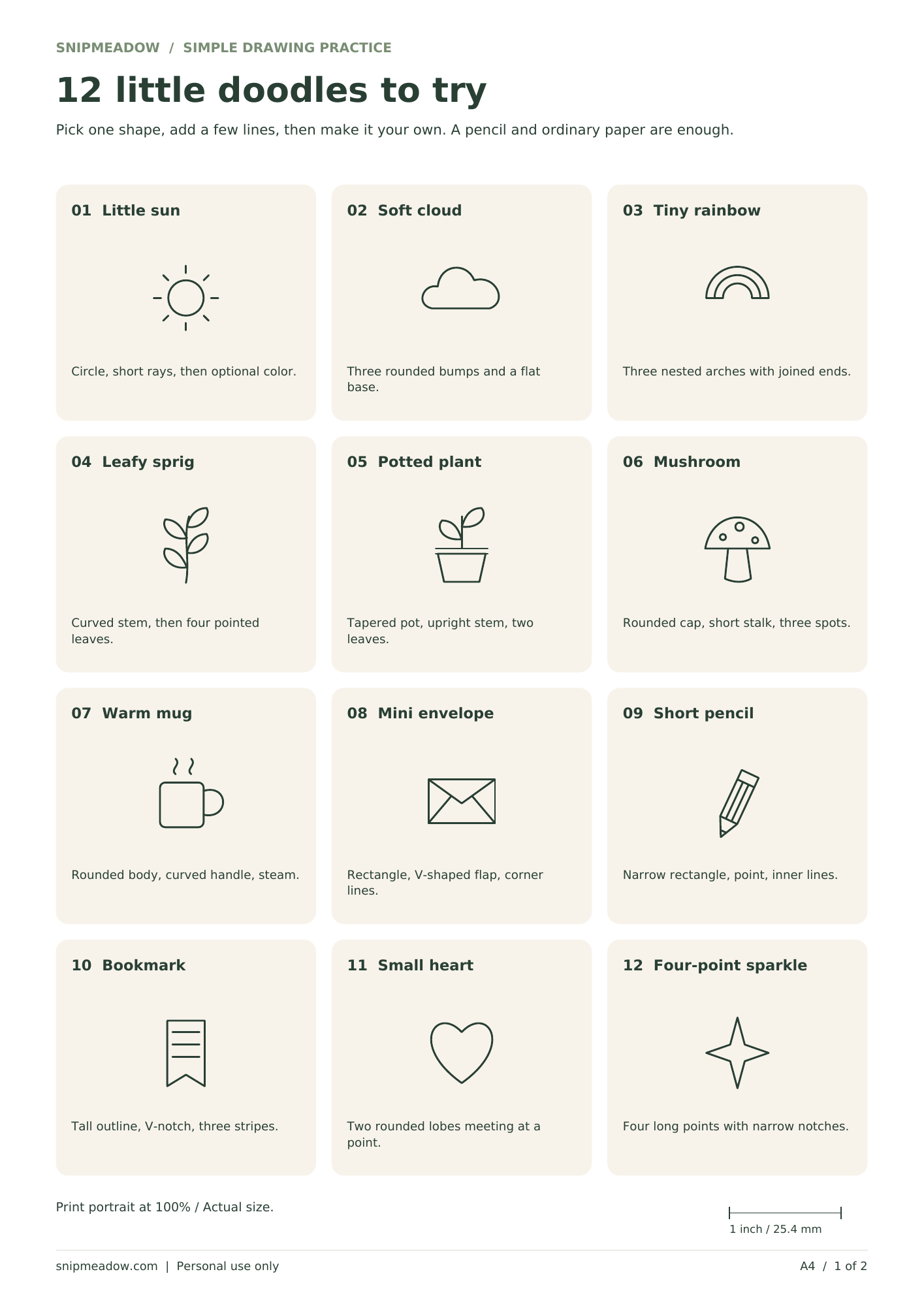
1. A little sun
Draw a small circle. Add short rays at the top, bottom, left and right, then place another ray between each pair. Leave a little gap between the circle and every ray so the outline stays clear. Finish with a light yellow center, or keep the whole drawing in pencil.
If the rays look uneven, compare their lengths before adding more. You can also make a softer-looking sun by using shorter rays. Place it beside a date or a short note about the weather.
2. A soft cloud
Begin with one large rounded bump for the top of the cloud. Add a smaller bump on each side, curve around the outer edges, and connect them with a fairly flat base. You can draw the outline in several short strokes; it does not have to be one continuous line.
Keep the bumps broad rather than adding lots of tiny scallops. For a rainy version, place three short strokes underneath. For a small weather row, leave the cloud plain beside your sun.
3. A tiny rainbow
Draw an upside-down U with both ends at roughly the same height. Add two smaller arches inside it, leaving similar spaces between the lines. Join the three ends on each side with a short horizontal stroke. The result is a simple rainbow outline with two bands to color.
Use two muted shades or leave the bands empty. If an inner arch touches the outer one, make the whole rainbow a little wider on your next attempt instead of squeezing in another line.
4. A leafy sprig
Make a gentle curved stem. Choose four points along it, alternating between the left and right sides. At each point, draw a curve out to a leaf tip and a second curve back to the stem. Keep the leaves slightly smaller near the top.
Let each leaf attach to the main stem. A small gap can make it look as though the leaf is floating. Try turning the finished sprig diagonally to decorate a page corner without taking space from your writing.
5. A potted plant
Draw a wide pot opening and two sides that slope inward toward a short base. Add a narrow rim across the top. From the middle of the opening, draw an upright stem with one leaf pointing left and another pointing right. Stop the stem at the opening rather than drawing through the pot.
A wider pot gives the plant a steadier appearance. Change its decoration with one stripe or a small dot pattern. Keep the first version to two leaves so there are fewer lines to fit together.
6. A spotted mushroom
Draw a rounded dome and close its base with a straight line. Under the middle, add two short lines for the stalk and join them with a shallow curve. Place three small circles inside the cap, leaving space between the spots and the outer edge.
This is a decorative mushroom doodle, so you can change the proportions freely. A wide cap with a short stalk looks especially simple. Try a second mushroom beside it at a smaller size rather than filling the first with extra detail.
7. A warm mug
Start with a rectangle that has softly rounded corners. On one side, draw a curved handle that joins the body at two points. Leave the side of the mug visible inside the handle. Add two short, gently wavy steam lines above the top, with a small gap before each one.
A plain body is enough, but a tiny heart or stripe can make a second version different. Pair the mug with a small book doodle to decorate a reading note.
8. A mini envelope
Draw a landscape rectangle. From the two top corners, bring sloping lines down toward one point near the center to form the flap. Add a line up from each bottom corner, stopping when it reaches the flap edge. Keep the middle clear so the folded shape is easy to read.
Try adding a tiny heart where the flap meets. You can also use the plain envelope beside a journal sentence about a letter, a message or someone you would like to write to.
9. A short pencil
Draw a narrow rectangle, then attach a triangle to one short end for the sharpened tip. Add a line across the opposite end for the eraser band. Inside the body, draw two long parallel lines, stopping at the band. Add a short mark across the pointed end to suggest the graphite.
Turn your paper slightly if diagonal lines feel awkward. Draw the pencil upright first, then rotate the next version on the page. Keep all the inner lines inside the outline rather than carrying them into the eraser.
10. A striped bookmark
Draw the top and two long sides of a narrow rectangle. At the bottom, bring a diagonal line inward from each corner so they meet in a shallow upward notch. Add three short stripes across the body. Leave a small gap between the stripes and both sides.
Make the bookmark wider if the stripes feel cramped. A leaf, dot or initial can replace the stripes on another attempt. This is a drawing exercise; the practice PDF is not a cutting template for a full-size bookmark.
11. A small heart
Lightly mark a top notch and a lower point. Curve out from the notch to make one rounded lobe, then bring the line down to the lower point. Repeat on the other side. Keep the lines loose and adjust the outer curves before making the outline darker.
The two sides do not need to match perfectly. Try a shorter, wider heart and a taller, narrower one to see which you prefer. Use one beside a favorite sentence instead of covering the whole margin.
12. A four-point sparkle
Lightly imagine a vertical line crossing a shorter horizontal line. Use their ends as four points. Connect each long point to the next with two short inward-sloping lines, making a narrow notch between them. Close the outline and erase any guide marks you used.
Keep the top and bottom points longer than the side points. One sparkle can fill a small gap beside a heading. Leave space around it so the four tips remain visible when you draw it at a smaller size.
Turn one doodle into a small journal detail
When you have tried a few easy doodles to draw when bored, choose just two that work together. A mug and bookmark can sit below a reading note; a plant and envelope can frame a short memory. Make a light pencil sketch first, leaving the main writing area open.
- Beside a date: use a sun, cloud or small heart as a single margin icon.
- At a corner: turn a leafy sprig inward toward the text, keeping its leaves out of the writing area.
- On a paper scrap: combine two icons with a few words, then tuck the scrap into a journal pocket.
For a flower to add later, follow our separate six-step daisy drawing tutorial. Keeping one detailed subject on its own practice page makes it easier to see what you want to change.
Easy doodles to draw when bored: free practice pack
The easy doodles to draw when bored pack comes in A4 (210 x 297 mm) and US Letter (8.5 x 11 inches). Both versions contain the same two pages. Choose the one that matches the paper in your printer.
- Page 1: twelve finished doodles with short shape reminders.
- Page 2: six pale examples to trace, with space beside each one for your own version.
Print in portrait orientation, one PDF page per sheet, at 100% / Actual size. The check line on page one should measure one inch, or 25.4 mm. Adobe explains the settings in its PDF page-size guide. The page dimensions and layout have been checked digitally; a physical printer test has not been completed.
The sheets are for personal use only. Please share this article link instead of redistributing or selling the PDFs. If you do not have a printer, keep the reference open on screen and draw on your own paper. The printable is optional, and all twelve ideas can be practiced without it.
Questions about easy doodles to draw when bored
Can I try these easy doodles to draw when bored on lined paper?
Yes. Use a notebook line as a baseline for a mug, envelope or plant. Keep larger shapes across several lines, and leave a gap between each drawing and your notes. Use a light pencil if the ruling distracts you.
Which doodle should a complete beginner try first?
Try the sun or cloud. Each starts with one simple outline and needs only a few additional marks. If curves feel awkward, begin with the envelope instead. Repeat one drawing two or three times before adding a more detailed subject.
Can I draw these with a pen instead of a pencil?
Yes. Start on a scrap of paper and accept small variations in the lines. Pencil is useful when you want to adjust a shape, but it is not required. With a pen, avoid retracing every wobble, which can make a tiny drawing look crowded.
What can I change if all my doodles look the same?
Change one feature at a time: a taller mug, a wider mushroom cap or a smaller leaf. Keep the other lines familiar so you can judge the difference. You can also use one accent color across several drawings to give a journal page a consistent look.


Looking for another little project? Explore Journaling, Printables or Paper Crafts.