
9 Easy Junk Journal Page Ideas for Beginners

These junk journal page ideas start with things you may already have: a paper scrap, a small memory, a favorite color or a few words. Choose one of the nine beginner layouts below, arrange the pieces before gluing, and leave a little space to write. You do not need a matching craft kit or a full page of decoration to get started.
These beginner junk journal page ideas include a simple arrangement, a writing prompt and one practical tip. There is also a free two-page printable with all nine illustrated layouts and three writing cards, in A4 and US Letter. The illustrations are starting points: change the colors, shapes and spacing to fit your own notebook.
Table of Contents
What you need for these junk journal page ideas
Gather a notebook, three or four paper scraps, scissors, a pen and a glue stick or other paper adhesive. Plain copy paper works for writing cards. An old envelope, clean wrapping paper or an unneeded paper bag can provide a background. Optional extras include paper tape, a ruler and a small photo copy.
Keep irreplaceable photos and keepsakes separate, and use copies in your journal. If you want to preserve originals, the Library of Congress guide to caring for photographs is a useful place to check storage and handling advice. The projects here are casual paper crafts, not archival preservation methods.
Before attaching anything, close the notebook with your loose arrangement inside. If it feels bulky, remove a layer. Leave room beside the binding and keep paper pieces within the page edges, unless you deliberately want a small tab. Write on a flat card before gluing it over other layers.
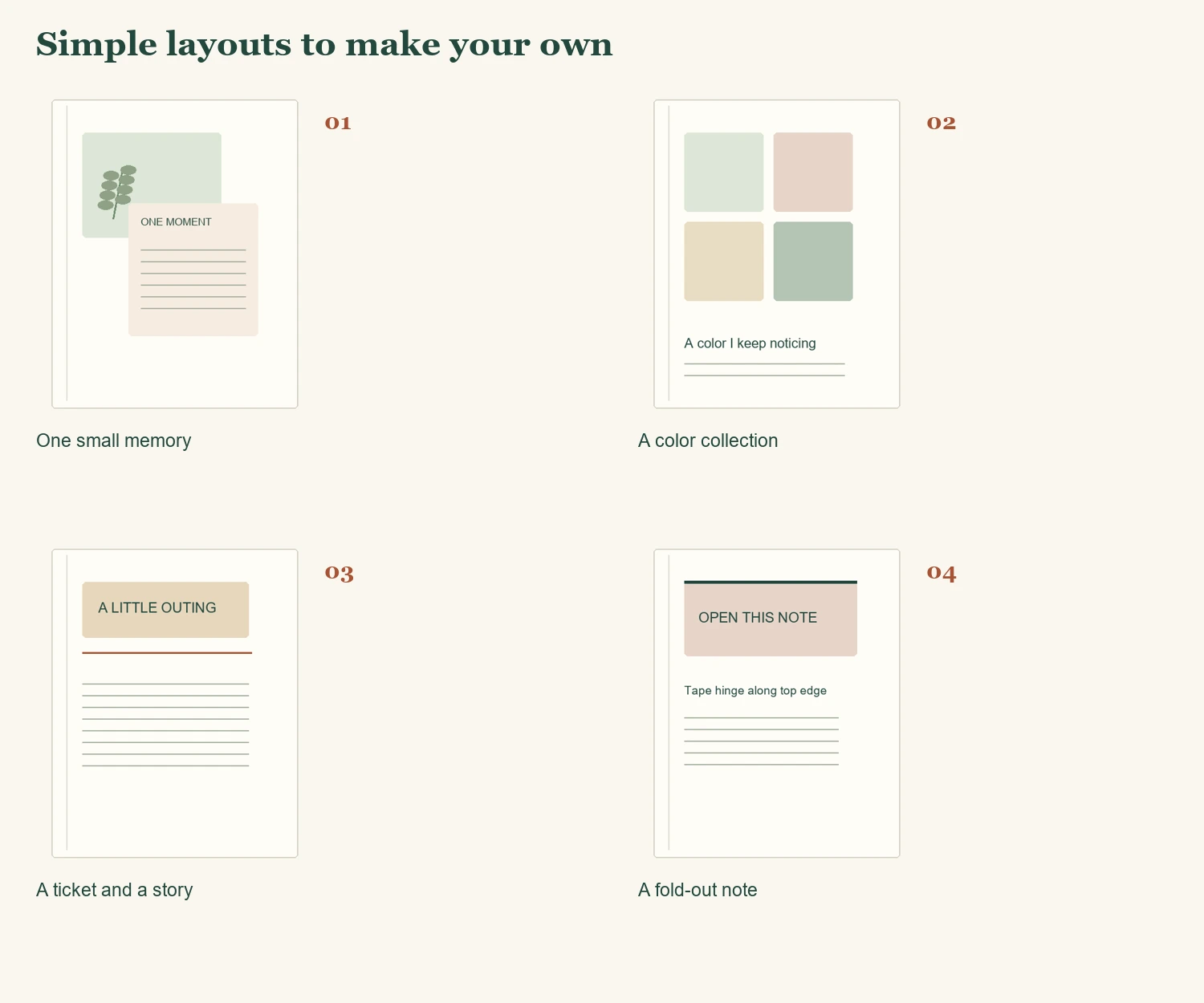
1. One small memory
Start with one moment rather than a whole day. A kind message, a quiet walk or breakfast with a friend is enough. Choose one colored scrap for the upper half of your page and a smaller plain rectangle for your words. A leaf doodle or a tiny paper illustration can sit on the colored scrap.
Make the layout: place the colored piece slightly to one side, then overlap its lower corner with the writing card. Write the date and two or three sentences before attaching the card. Keep a visible margin around the arrangement so the words remain the focus.
Writing prompt: What small detail would I forget if I did not write it down? Try describing a sound, a color or a sentence someone said. For a fuller example, use our memory journal page guide.
2. A color collection
This is one of the easiest junk journal page ideas when you want to make something without telling a long story. Choose four scraps that share a color or feeling: soft greens, warm browns, pale pinks or a brighter combination from your own supplies. Mix plain and patterned paper so every square does not compete for attention.
Make the layout: trim the scraps into roughly similar squares and arrange them in a two-by-two grid. Leave a narrow gap between each piece. Position the grid toward the top and add a one-line caption below. Move the pieces around until you like the balance, then glue them.
Writing prompt: Where have I noticed these colors lately? Your answer could be a garden, a shop window or a favorite sweater. If the papers are busy, keep the caption area plain and skip extra embellishments.
3. A ticket and a story
Give a small outing its own page. Use a copy of a ticket, a simple label you draw yourself or a rectangle with the name of the place. You can make this layout even if you did not save a physical souvenir. The little label in our illustration is an example, not a downloadable admission ticket.
Make the layout: place the ticket or label near the top. Draw a short line underneath, then leave the lower half for the story. Add the date, who you were with and one detail that made the outing memorable. If the original ticket contains a booking code or personal information, leave that out of any photo you share.
Writing prompt: What happened between arriving and leaving that I want to keep? A small everyday trip can be just as useful as a holiday for this page.
4. A fold-out note
For interactive junk journal page ideas, a flap creates a second writing space without filling the page with decoration. Cut a small paper rectangle that fits comfortably above the middle of your page. Write a short label on the front, such as “open this note,” and put a longer message underneath it on the journal page.
Make the layout: attach the top edge of the rectangle with a strip of paper tape, half on the flap and half on the page. Keep the other three edges free. Lift it gently to check that it opens before decorating around it. Test your tape on a spare scrap if the paper is thin or fragile.
Writing prompt: What would I like to tell my future self? This flap adds a playful reveal, but it is not a secure place for confidential information. Leave space beneath it for a sentence you want to see without opening it.
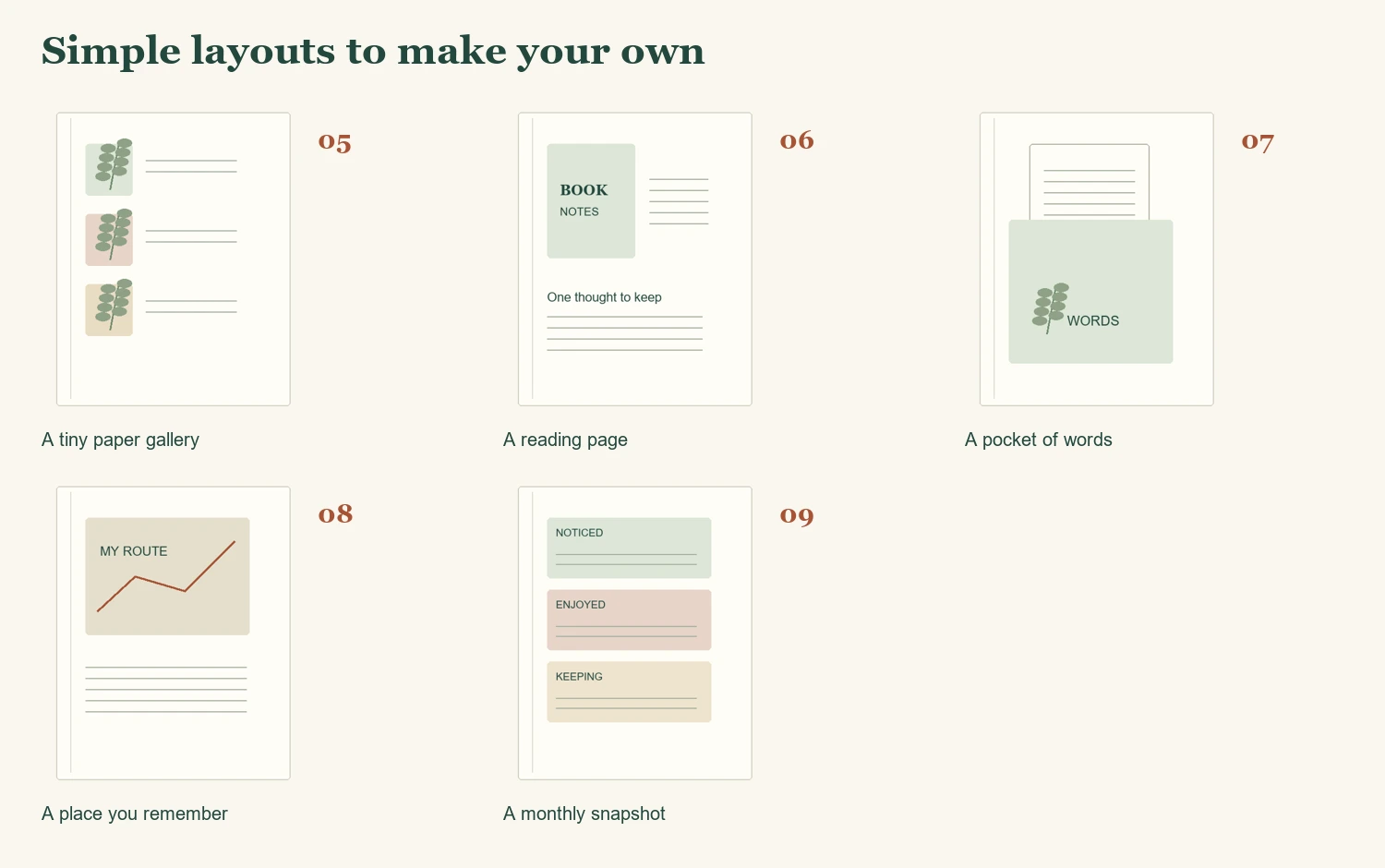
5. A tiny paper gallery
Turn three small scraps into a miniature collection. They could hold leaf doodles, a repeated stamp you already own or three little drawings. Repeating one motif makes the pieces feel connected even when the background colors differ. Our reference sheet uses leaves as an example.
Make the layout: arrange three small rectangles down the left side of the page. Leave enough space between them for each to stand on its own. Add a short caption to the right of each one, lining the words up with the center of the picture. Keep the remaining page plain.
Writing prompt: Which three things caught my attention this week? If drawing feels difficult, use three shapes cut from colored paper and describe what each reminds you of. You can also use our free botanical tags as small accents.
6. A reading page
A reading page records your response to a book without becoming a formal review. Make a small “book notes” panel from a paper rectangle and place it beside a few lines for the title and author. Leave the bottom of the page for a thought you want to return to.
Make the layout: put the colored panel in the upper-left area and write the book details to its right. Under both, add a short paragraph in your own words. You might note a character, an idea or a question the book raised. A tiny drawn book spine can replace a printed cover image.
Writing prompt: What stayed with me after I closed the book? Use this arrangement for a library visit or a reading list too. Keep your notes short enough that you can read them comfortably without shrinking the handwriting.
7. A pocket of words
Use a small flat pocket to hold a note you can take out and reread. A paper envelope can work, or you can make a pocket from one of our free printable junk journal pocket templates. Choose the insert first so you know how much space it needs.
Make the layout: place the pocket in the lower half of the page and let the top of the writing card show. Follow the pocket template’s folding and gluing instructions, keeping its opening clear. Decorate the front with one small motif and a short word. Allow the adhesive to dry before inserting your note.
Writing prompt: What words would I like to find again on a difficult day? Keep the card flat and easy to remove. A thick stack of notes can stretch a paper pocket and make the journal hard to close.
8. A place you remember
You do not need an accurate map to remember a place. Draw a simple line for a walk, a journey between two landmarks or the route to a favorite spot. Add two or three dots with short labels if you like. Treat it as a memory sketch rather than directions someone should follow.
Make the layout: draw your route on a separate rectangle and place it in the upper half of the page. Keep the line clear against a plain background. Under the sketch, write what you noticed along the way: weather, a smell, a conversation or something unexpected.
Writing prompt: Which part of this place do I remember most clearly? If you plan to photograph the page publicly, avoid showing your home address or other private locations. A made-up route label is fine for a personal visual reminder.
9. A monthly snapshot
Finish with three small sections instead of a long monthly recap. Label them “noticed,” “enjoyed” and “keeping.” This is an easy layout to repeat throughout the year because the structure stays familiar while the memories change. You can use it for a week or a season as well.
Make the layout: cut three wide paper rectangles and stack them vertically with a little space between them. Write one label on each, then add a sentence or a few words. Put the month and year at the top of the page. Use thin paper so the repeated panels do not add too much bulk.
Writing prompt: What is one ordinary thing from this month that I would like to remember next year? If you have more to say, add a loose writing card rather than covering every open area with another layer.
Download the free junk journal page ideas printable
Keep these junk journal page ideas beside your supplies as a quick reference. The free PDF has two pages. Page one is an illustrated reference sheet showing all nine layouts. Page two is a writing worksheet with three outlined cards: “A moment to keep,” “A color or feeling” and “Words for later.” Use the worksheet whole or cut out the cards to suit your notebook.
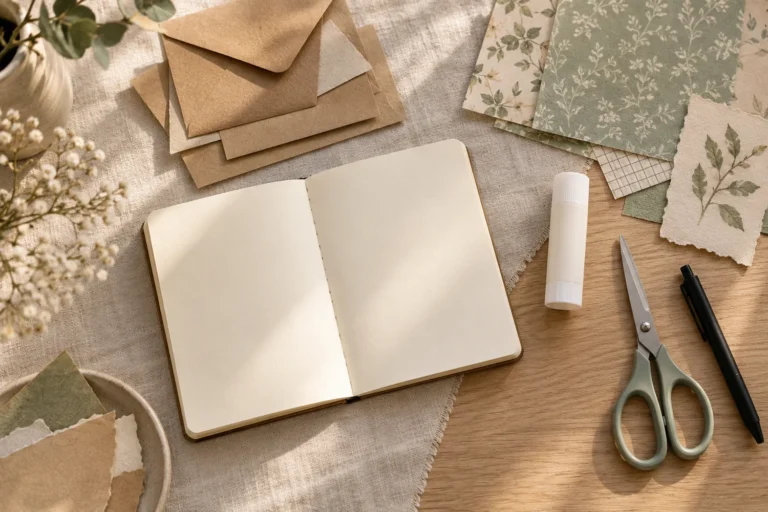
Choose the PDF that matches your paper size. “Fit to page” is fine for this reference sheet and worksheet because neither depends on exact measurements. The nine diagrams are not full-size cutting templates, and the decorative papers in the cover image are not included. No email signup is needed to download.
Personal use only. Print copies for your own journals and personal gifts. Please share this article link instead of uploading, reselling or redistributing the files.
Questions about these junk journal page ideas
What should I put on my first page? Choose one scrap and one sentence. The memory-card layout is a useful starting point because it gives you a clear place for both. You can add the date and stop there; your first page does not need to explain your whole journal.
Can I make these pages without a printer? Yes. The printable is optional. Copy a layout with a pencil, cut writing cards from plain paper and use scraps you already own. All nine ideas can be adapted to a small notebook or a larger journal.
How do I stop a page looking too crowded? Choose one focal piece, limit yourself to a few papers and leave a clear area for writing. Before gluing, remove one decoration and compare the result. If two patterned pieces compete, put a plain paper layer between them.
Do these junk journal page ideas work all year? Yes. Use the same arrangements with seasonal colors or everyday memories. A color collection can become autumn browns or spring greens; the monthly snapshot works whenever you want to pause and take note.
Save these junk journal page ideas for the next time a blank page feels intimidating. Start with the layout that fits the scraps in front of you, write one honest detail and let that be enough for today.

Looking for another little project? Explore Journaling, Printables or Paper Crafts.