
How to Start a Gratitude Journal: 7 Easy Steps
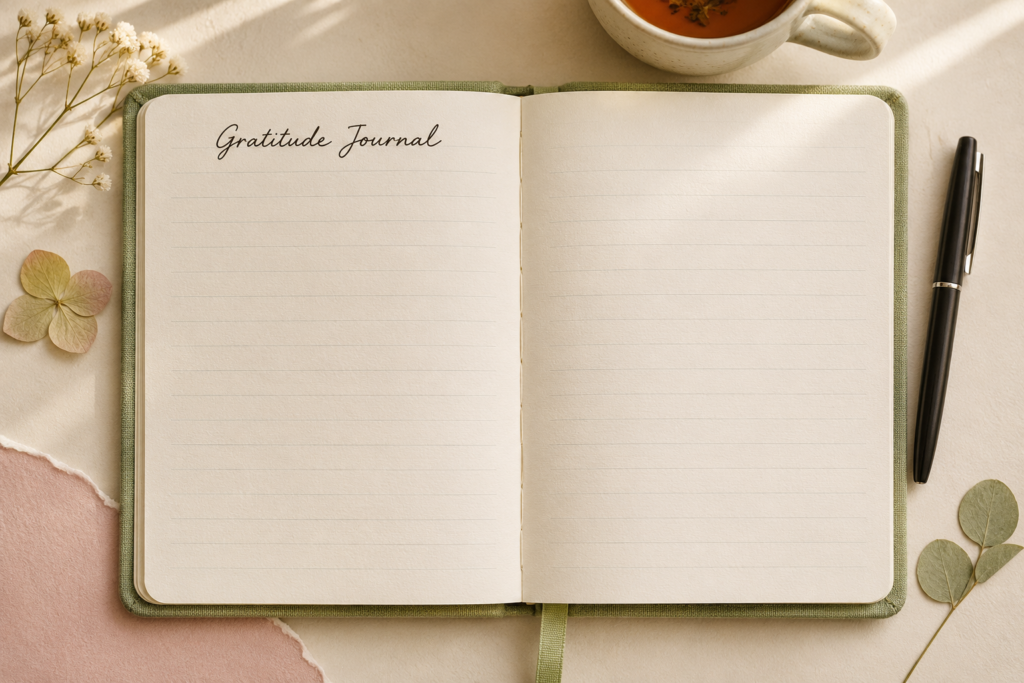
A gratitude journal gives ordinary moments a place to stay: a helpful conversation, a meal someone made, or ten quiet minutes with a project you enjoy. You can start with a notebook you already own and a few lines about one thing you appreciate.
To start today, date a page, describe one specific moment, and add why it mattered to you. Leave the next entry for another day. There is no need to buy a guided journal, design a perfect spread, or fill a whole page before your journal counts.
This beginner guide helps you choose a format, set up your first page, and find a manageable writing rhythm. You will also see original example entries and a simple botanical layout. If you already have a notebook and mainly need questions to answer, go to our 31 gratitude journal prompts and free printable.
Download the free gratitude journal printable
Start with our existing 31-prompt pack: two prompt sheets, a reusable writing page, and six prompt cards. Choose the paper size that matches your printer; both versions contain the same four pages.
Free for personal use. Print only the pages you need, and reuse the writing page whenever you want a fresh start.
Table of Contents
What is a gratitude journal?
A gratitude journal is a written record of things you appreciate and the experiences behind them. It can be a separate notebook, a section in a planner, a few loose pages, or a digital document. Its defining feature is the subject of your entries, rather than a particular cover or page design.
A diary may describe everything that happened during a day. A gratitude journal usually zooms in on a smaller part: the person who helped, the place you were glad to visit, or the detail you want to remember. Both kinds of writing can share the same notebook.
The practical appeal is having a personal collection to revisit. A sentence about an ordinary Tuesday can preserve something that a calendar entry would miss. You can write for that reason alone, without setting yourself a goal to become happier or more productive.
For background, the Greater Good Science Center at UC Berkeley offers a gratitude journaling practice that emphasizes concrete details and reflection. This guide focuses on setting up your own notebook; it does not promise a particular health outcome.
Choose a gratitude journal format you will use
Try a few entries with supplies you already have before buying a new journal. The useful question is whether the format makes it easy to write when a moment comes to mind. Use this comparison to choose a starting point.
| Format | A good fit when… | Check before choosing |
|---|---|---|
| Plain or lined notebook | You want room for short notes or longer stories. | Does it open comfortably, and does your pen show through? |
| Guided journal | You like having a question or repeated structure ready. | Do the sample questions suit you? Is there enough writing space? |
| Printable pages in a binder | You want to add, move, or replace pages. | Can you store the sheets where you will find them again? |
| A section in an existing journal | You prefer keeping your writing in one place. | Will a tab or a simple heading help you find these entries? |
| Private notes on your device | You usually have your phone or computer nearby. | Choose one note or folder so entries stay together. |
For a paper version, start with a notebook and pen. A date stamp, stickers, markers, and decorative paper are optional. An undated notebook leaves room to pause without leaving rows of empty dated pages. If you want to make the notebook itself, our beginner junk journal guide explains a simple paper-based starting point.
How to start a gratitude journal in 7 easy steps
1. Give the journal a small, personal purpose
Write one line inside the cover about what you want to keep. For example: “Small moments I would otherwise forget,” or “People and details I want to notice.” This opening line can help you decide what belongs on the page when the topic feels too broad.
You do not need an introduction about your whole life. Leave the first page blank if writing a beginning makes you hesitate. Your first dated entry can be the beginning.
2. Set up one page with plenty of room
Put the date at the top. Beneath it, leave space for an entry, then a gap before the next one. On a small notebook page, one entry may be enough. On a larger sheet, you might fit three short entries without dividing the page into rigid boxes.
Use an ordinary pen for the first week. If you later want color, add it to the heading or outer margin. Keeping the writing area clear makes it easier to continue an entry without squeezing words between decorations.
3. Choose a moment you can actually recall
Pick something from today, yesterday, or another recent day. Look for an action or a scene: someone explained a confusing instruction, you found a comfortable seat, or a familiar path looked different in the evening light.
A subject such as “friendship” is a starting point. Ask yourself which moment made you think of it. That remembered scene supplies the material for your gratitude journal entry.
4. Write the detail and its meaning
Use this simple pattern if the blank page slows you down: what happened + the detail I want to keep + why I appreciate it. You can combine all three in one sentence. Fragments and bullet points are fine, too.
For example, “I appreciate my local library” could become: “The librarian found the sewing book I could only describe by its blue cover. I left with the pattern I wanted to try.” The second version gives your future self a small story to return to.
5. Stop at a useful amount
Begin with one completed thought. Add a second or third if another moment comes easily, but do not turn the number into a requirement. A short entry you recognize as your own is enough for this notebook.
If you enjoy longer writing, follow that interest. Add the setting, the conversation, or what happened next. The format should leave you room to write more without demanding more every time.
6. Choose your next writing moment
Pick a realistic opportunity to return: after closing your planner on Sunday, during a quiet lunch break, or before putting your book away at night. Keep your journal and pen together so the next entry does not begin with a search for supplies.
For a first trial, choose two moments in the coming week. That is a practical starting schedule, not a scientifically optimal dose. Adjust it after you see what suits your days. If you miss one, continue on the next date without filling in the gap.
7. Review the setup after a few entries
Look at what made writing easy or awkward. Did the page feel too small? Were the prompts helpful? Did you keep forgetting where you put the notebook? Change one practical thing, such as moving it beside your reading chair or using shorter entries.
Keep any decoration you enjoy, and drop anything that makes opening the journal feel like a larger project. You can revise the layout on the very next page; the pages do not need to match.
Gratitude journal examples in three formats
These invented examples show different ways to arrange an entry. They are not copied from a real person’s private journal. Use the format that feels comfortable, replacing the details with something you remember.
A single sentence
November 6 — I found a handwritten label on the seedlings at the community garden, so I finally learned the name of the plant I keep admiring.
This format suits a quick note. It names a particular detail and explains what it made possible. You could stop there or add a tiny sketch of the leaf.
A short list with a reason beside each item
- A repaired zipper: my favorite bag is usable again, and the small repair saved it from sitting forgotten in the cupboard.
- A shared recipe: my cousin sent the ingredient amounts, so I could make the dish without guessing.
- A clear corner of the table: I had somewhere to spread out my paper project after dinner.
The reasons keep the list connected to a day. You do not need to find three different categories or include a person, place, and object every time.
A longer entry about one ordinary scene
November 9 — The rain stopped while I was waiting outside the station. There was a little row of birds shaking water from the hedge, and I watched them until the bus arrived. I want to remember how much was happening in that small patch of green. I usually look down at my phone there.
A longer entry gives you space for setting and observation. It does not need to end in a lesson, a goal, or a promise to change your routine.
Make a simple botanical gratitude journal page
If you enjoy the paper side of journaling, build the page around your writing. A useful arrangement is a date in the top corner, a short heading, and a wide open area underneath. Choose one accent: a leaf doodle, a strip of paper, or a small removable card.
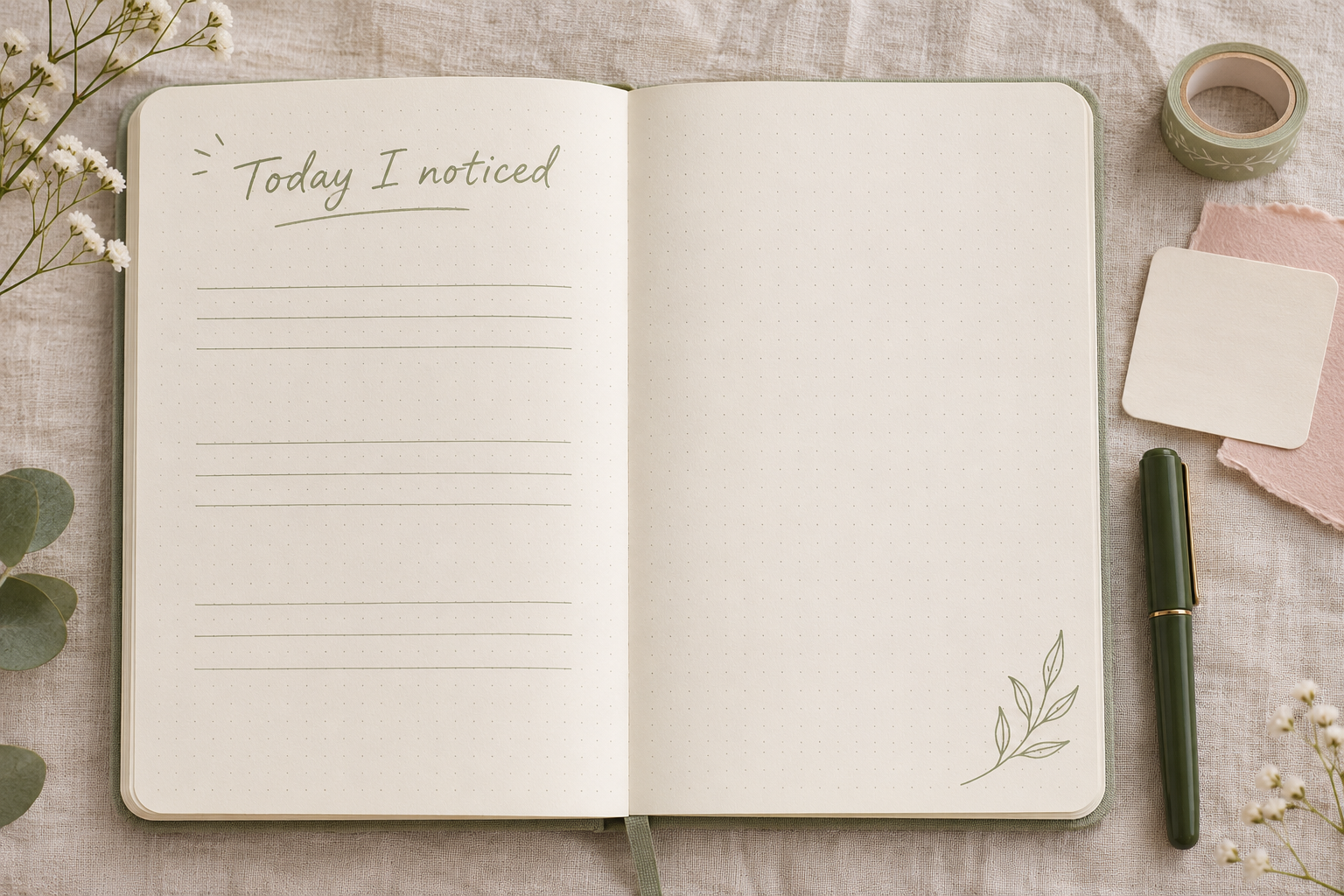
For a flat layout, write first and add a narrow paper strip along the outer edge afterward. Keep glue and layered paper away from the center fold so the notebook still closes comfortably. Test a marker on a spare page before using it beside your writing.
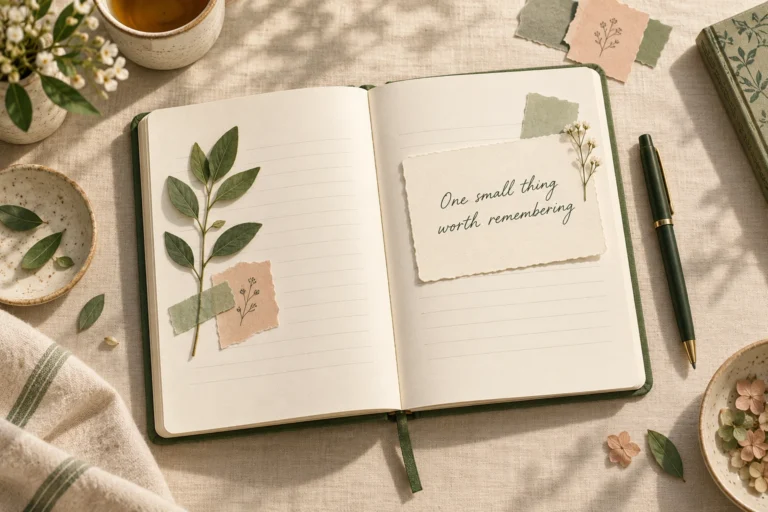
For a removable note, write on a small card, then tuck it into a pocket or attach it with a paper clip. Leave the back available for extra details. Our botanical junk journal ideas offer more ways to use quiet colors and paper details around a clear writing space.
You can also use the writing sheet in our free gratitude prompts printable. That existing four-page pack includes 31 questions, a reusable writing page, and six prompt cards in A4 and US Letter versions. Choose the size you need; the two versions contain the same collection.
Keep gratitude journaling flexible
When the entries start repeating
Return to a familiar subject through a different moment. If you often write about a sibling, describe one recent conversation or something you did together. You can appreciate the same person many times without requiring yourself to discover a new category each week.
When you miss a week
Use today’s date and begin where you are. There is no need to reconstruct seven entries or explain the blank space. If the schedule kept slipping, choose a different cue or leave the journal somewhere more convenient.
When the day was difficult
You can record a small kindness and still write that the day was disappointing. Cleveland Clinic’s guide to gratitude journaling also makes room for difficult feelings rather than requiring a cheerful account.
If gratitude does not feel available, skip the entry or use the page for ordinary journaling. You do not have to feel thankful for an upsetting experience. Keep the notebook useful to you instead of treating each page as a test.
When you want to share a page
You can photograph a decorated spread without posting the private writing. Use a blank example card, close a folded note, or choose a page that contains only details you want to share. Keeping some entries just for yourself is part of choosing your own format.
Gratitude journal questions
What do you write on the first page of a gratitude journal?
Write the date and one moment you appreciate. You can add a sentence about why you are keeping the journal, but a title page and introduction are optional. Begin on the second page if saving the first one for later helps you get started.
Do you need a special gratitude journal?
No. A notebook, loose sheet, or private digital note works. If you prefer a guided journal, inspect a sample page before buying: look for questions you want to answer, enough writing space, and a format that allows your preferred pace.
Should you write in the morning or at night?
Choose the time when you can comfortably pause. An evening entry can describe that day; a morning entry can remember the previous day. You do not need new events to have happened since waking up.
How long should a gratitude journal entry be?
One specific sentence can be a complete entry. Use a few bullets or a paragraph when you have more to say. Let the amount follow the moment you are recording rather than trying to fill a fixed number of lines.
Can a gratitude journal be part of a junk journal?
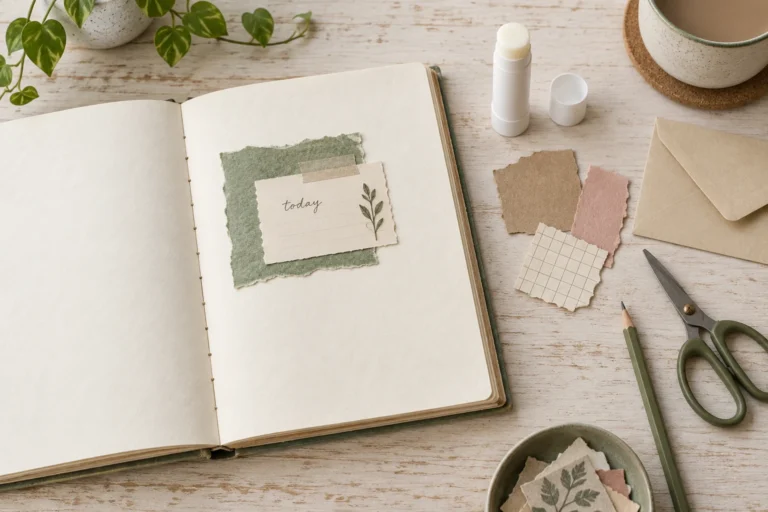
Yes. Reserve a few pages, tuck entries into a pocket, or put dated notes beside a paper keepsake. A memory journal page can hold both the written detail and a small reminder from the day.
Start with the next available page. Add a date and a moment you want to keep. If choosing the subject is the difficult part, open the gratitude journal prompts collection and choose one question that fits today.

Looking for another little project? Explore Journaling, Printables or Paper Crafts.